 Robin Marksman
- Frase and Surfer start at $49 a month (Frase billed monthly, Surfer billed yearly), and Clearscope at $129 a month with a 14-day trial.
- Action platforms that make fixes for you cost more: Goodie Core is $354 a month billed monthly ($295 billed annually) and AthenaHQ Starter is $295 a month.
- The line between trackers and AEO tools is fading: Frase Starter now tracks 20 prompts, Goodie Core bundles 110 prompts with 50 optimizations a month, and Profound's AI Marketer rewrites pages and stages them in your CMS.
- Bing Webmaster Tools' AI Performance report, free and in public preview since February 2026, shows how often Copilot and Bing's AI summaries cite your pages.
- Yoast and Rank Math both generate llms.txt in their free plugins, but Google says its Search doesn't use llms.txt.
- In a 1,000-question test, on-page signals changed citation odds only in Claude, so treat any tool's "AEO score" as a writing aid, not a ranking prediction.
What are AEO tools?
AEO tools are products that help you make content more likely to be retrieved and cited by AI answer engines such as ChatGPT, Perplexity, Gemini, Claude and Google AI Overviews. Answer engine optimization has two halves: measuring where you show up, and changing it. This page is about the second half.
Measurement (prompt tracking, share of voice) is the first half. Eleven trackers go head to head in our AI visibility tools guide, and one-off checks get their own write-up in the roundup of free AI visibility checkers. A few trackers do show up below, but only for their fix features.
The tools here do five jobs. Most teams need two or three, not all five.
| Job | What the tool does | Picks on this list |
|---|---|---|
| Content optimization | Scores and rewrites pages against the questions and sub-queries AI engines search for | Frase, Clearscope, Surfer, Semrush Content Toolkit |
| AI action platforms | Find gaps in AI answers and generate or apply fixes | Goodie, Writesonic, AthenaHQ |
| Technical access | Check that AI crawlers can fetch and read your pages, and get pages indexed | Screaming Frog, Bing Webmaster Tools and IndexNow |
| Schema and entities | Generate and validate structured data and entity markup | InLinks, WordPress SEO plugins |
| Question research | Show the follow-up questions people ask | AlsoAsked |
How are AEO tools different from AI visibility trackers and SEO tools?
An SEO tool tells you where a page ranks in a list of links. An AI visibility tracker tells you whether an AI answer names or cites you. An AEO tool helps you change the page, the markup or the crawl access so the next answer is more likely to use you. You need the first two to know where you stand and the third to move.
| Type | Question it answers | Typical output | Entry price examples |
|---|---|---|---|
| SEO tool | Where do my pages rank in Google's links? | Positions, keyword volumes, backlinks | Semrush SEO plan $139.95/mo billed monthly |
| AI visibility tracker | Do ChatGPT, Gemini, Perplexity or AI Overviews mention or cite me? | Mention rate, citations, share of voice per prompt | HubSpot AEO $50/mo (25 prompts); Semrush AI Visibility Toolkit $99/mo (25 prompts); Ahrefs Brand Radar from $199/mo per platform |
| AEO tool | What do I change so the answer uses my page? | Briefs, rewrites, fixes, crawl reports, schema, question lists | The 12 picks below, from $0 to $354/mo |
The categories are merging from both sides. Content tools now track a few prompts: Frase's Starter plan covers 20 prompts on ChatGPT and Google AI, and Surfer sells an AI Search Analytics plan with 50 prompts refreshed daily. Trackers now write. Goodie's Core plan pairs 110 prompts with 50 optimizations a month, and Profound's AI Marketer, by its own description, "rewrites pages with citation decay and stages them in your CMS". So the label on the box tells you less than the plan table does. Look at how many prompts a plan tracks and how many fixes it ships each month, then compare those two numbers with what you actually need. Read the full comparison table as well, because country caps and API access often sit there, as our look at the plan limits that catch Peec and Profound buyers shows.
Most pages ranking for "best AEO tools" list trackers almost exclusively. We think that's backwards for most teams. If an engine can't fetch your page, or the page never answers the question in its first lines, a better dashboard just shows you the same zero every week.
How did we pick and order these 12 tools?
Every tool on the list had to change something you control (a page, its markup, crawl access or the list of questions you write for), publish a price we could read on its own pricing page, and offer some free way in: a trial, a free plan or a free version.
- Does it fix, or only report? Tools that only report belong in a tracker roundup. Every pick here produces something you ship.
- Does the fix match how engines retrieve? Engines fetch pages from an index, fan a question out into sub-queries and quote short passages. We favored tools that work on those three steps (access, sub-query coverage, answer-first passages) over tools that score keyword density.
- What does a real month cost? We list the billing basis next to every price, because Surfer, Semrush and Writesonic show yearly-billed prices up front, and credit plans (Goodie, AthenaHQ) cap what you can do regardless of the sticker price.
- Is there a free tier that does real work? Several picks do useful work at $0 with no time limit: Bing Webmaster Tools, Screaming Frog's free crawler, the free WordPress plugins and AlsoAsked's free searches.
We left off tools whose price we couldn't check, and we didn't rank anyone on unpublished citation results. None of these vendors has published a controlled test showing its recommendations raise citation rates, so the order is our judgment of usefulness per dollar, not a measured outcome.
How do the 12 AEO tools compare?
Prices are the cheapest paid plan on each vendor's pricing page, with the billing basis, because several vendors show only annual-billed prices. For trackers alone, our AI visibility tool pricing study converts each plan to a cost per tracked prompt.
| Tool | Best for | AEO feature that matters | Cheapest paid plan | Free option |
|---|---|---|---|---|
| Frase | Small teams writing answer-first content | GEO optimization and GEO score | $49/mo monthly ($39 yearly) | 7-day trial |
| Clearscope | Editorial teams with writers | Query fan-out awareness | $129/mo, no contract | 14-day trial |
| Surfer | Content teams that also want light AI tracking | GEO content optimization, fan-out insights | $49/mo billed yearly | No free plan |
| Goodie | Teams that want fixes generated for them | Technical Agent, llms.txt and sitemap repair | $354/mo monthly ($295 yearly) | 7-day trial |
| Writesonic | Teams already writing with AI | Action Center, Technical Actions | $79/mo billed yearly (actions from $399/mo) | Free start, no card |
| AthenaHQ | Tracking plus guided fixes in one tool | Content optimization agent | $295/mo monthly | Free Essential plan |
| Semrush Content Toolkit | Semrush users | AI and SEO content optimization, brief generator | $60/mo billed annually | 7-day trial |
| Screaming Frog | Technical audits at scale | JavaScript rendering, structured data validation | £199/yr per licence | Free up to 500 URLs |
| Bing Webmaster Tools | Seeing real AI citations | AI Performance report, IndexNow | Free | Free |
| InLinks | Entity schema without a developer | Schema automation | From $49/mo | Free plan |
| Yoast, Rank Math, AIOSEO | WordPress sites | llms.txt and schema generators | From $49.50/yr (AIOSEO Basic, first year) | Free plugins |
| AlsoAsked | Finding follow-up questions | People Also Ask mapping | $12/mo | Limited free searches |
What does each AEO tool cost per month?
The paid entry plans run from $12 to $354 a month, a spread of almost 30 times. The cheap end buys one job done well (questions, briefs, scoring). The expensive end buys tracking plus generated fixes, metered by credits.
| Plan | Listed price | Billing basis | What the price buys |
|---|---|---|---|
| AlsoAsked Basic | $12/mo | Monthly ($144 a year) | 100 credits for question searches |
| Frase Starter | $49/mo | Monthly ($39 billed yearly, $468) | Editor, briefs, SEO and GEO scores, 20 AI prompts on ChatGPT and Google AI |
| InLinks Freelancer | From $49/mo | Monthly, cancel anytime | Entity schema and internal links |
| Surfer Discovery | $49/mo | Billed yearly only | Content optimization, no AI prompt tracking |
| Semrush Content Toolkit | $60/mo | Billed annually | AI and SEO content optimization, brief generator |
| Writesonic Starter | $79/mo | Billed yearly | Mainly the AI writer; actions start on Growth |
| Clearscope Essentials | $129/mo | Monthly, no contract | Write and Optimize, query fan-out awareness |
| AthenaHQ Starter | $295/mo | Monthly | 3,600 credits, 11 models, content optimization agent |
| Goodie Core | $354/mo | Monthly ($295 billed annually) | 110 prompts, 5 core models, 50 optimizations a month |
| Screaming Frog | £199/yr | Per licence, yearly | Unlimited crawling; free version stops at 500 URLs |
The 12 best AEO tools, reviewed
The order reflects how much each tool helps the average B2B or content team do AEO work per dollar. We built it from the vendors' own feature and pricing pages; we didn't run controlled tests on citation outcomes, and no tool has published one either.
1. Frase: best for answer-first content
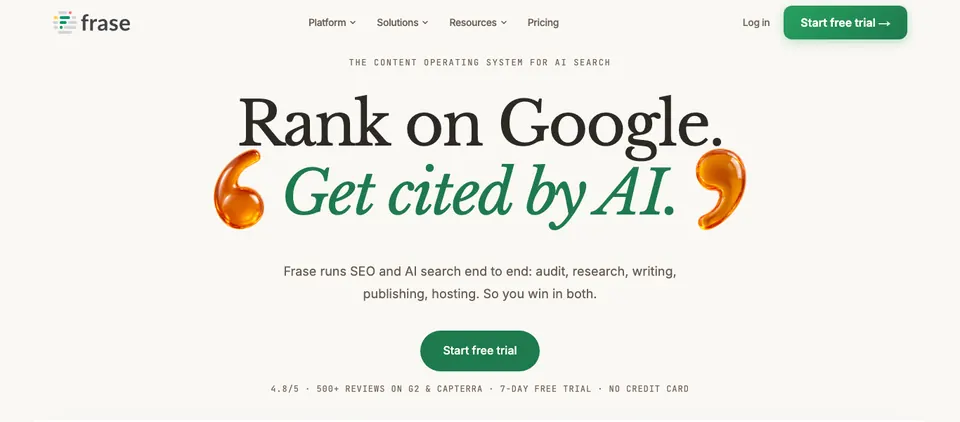
Price: Starter $49/mo billed monthly, $39/mo billed yearly; Professional $129/mo billed monthly, $103/mo billed yearly; 7-day trial, no card (Frase).
Frase has moved furthest toward AI search of the classic content tools. Its pricing page lists "GEO Optimization" ("Tune content to get cited by AI"), SEO and GEO scores on every plan, and "AI crawler monitoring" from the Professional plan up. Starter also tracks 20 AI prompts on ChatGPT and Google AI; Professional raises that to 50 and adds Perplexity. If you host pages on its FraseCMS, it adds structured data and llms.txt to every page. For a small team, the Starter plan puts research, briefs and an answer-first editor in one place.
The catch is the score. A "GEO score" is Frase's model of a good page, not a measurement of citations, so use it to catch thin sections, not as proof you'll be quoted.
2. Clearscope: best for editorial teams
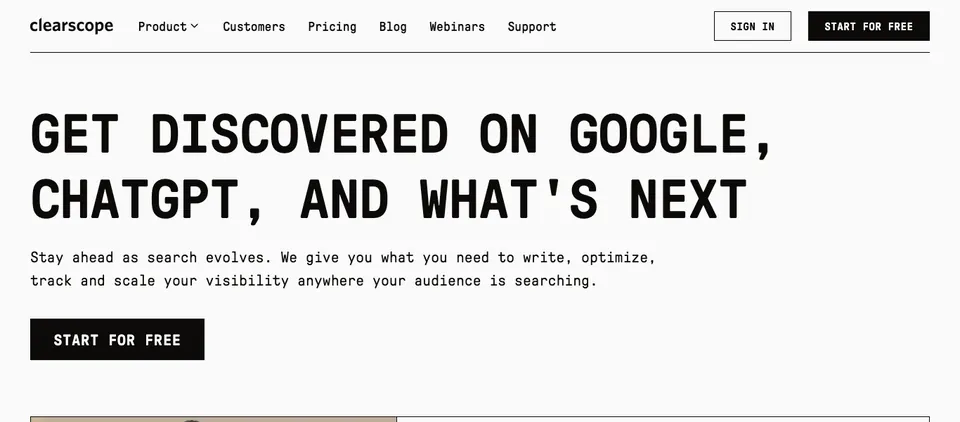
Price: Essentials $129/mo, monthly, no contract; 14-day trial (Clearscope).
Clearscope's most useful AEO feature is "Query fan-out awareness," which it describes as seeing "the web searches AI platforms trigger to construct their answers". That maps directly onto how Google AI Overviews and Gemini retrieve sources, through related sub-queries. It also tracks queries in ChatGPT and Gemini. Its Write and Optimize modules, drafts and topic explorations are built for writers and editors rather than analysts, so it fits a team that works with freelance writers.
3. Surfer: best if you want optimization and light tracking together
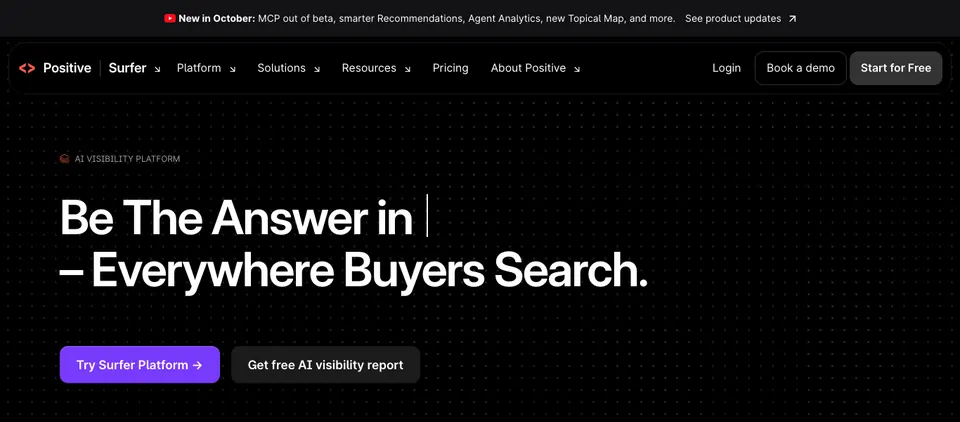
Price: Discovery $49/mo billed yearly; Standard $99/mo billed yearly; AI Search Analytics $82/mo billed yearly. Monthly prices aren't shown, and the FAQ says yearly plans save up to 17% (Surfer).
Surfer lists "GEO content optimization," AI SEO guidelines and a Content Score, and its AI Tracker page pitches "Topical Map and Fanout Queries insights" alongside writing missing "AI-ready articles" in the Content Editor. AI prompt tracking starts on Standard with 25 prompts checked weekly, and the Standard tracking card shows ChatGPT only. That's enough to see whether a rewrite moved anything on a handful of prompts, not enough to replace a dedicated tracker. If tracking matters more than writing, the separate AI Search Analytics plan checks 50 prompts daily for $82 a month billed yearly, and its plan card lists no content documents.
4. Goodie: best for fixes done for you
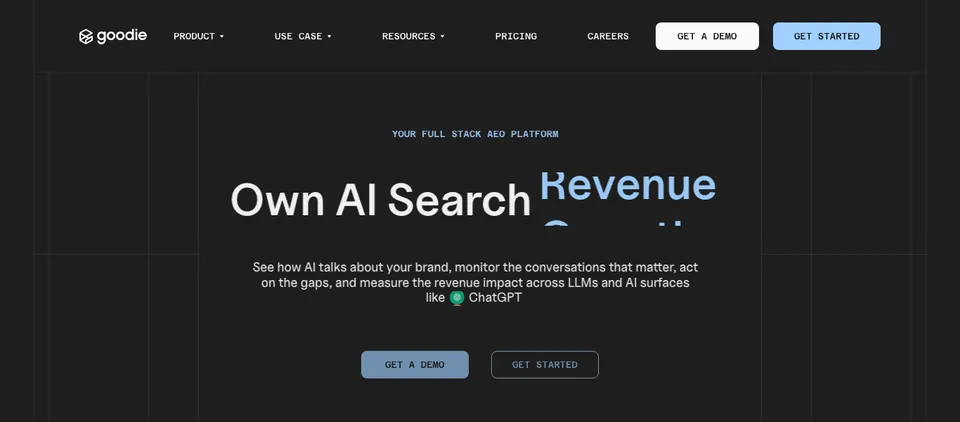
Price: Core $354/mo billed monthly, or $295/mo billed annually (two months free, $3,540 a year); 110 prompts on 5 core models and 50 optimizations a month; 7-day trial (Goodie).
Goodie is the clearest example of a tracker turning into a doer. Under "Agents and Optimizations" it lists an AEO Content Writer, Content Optimization, a Technical Agent, "LLM.txt + Sitemap Repair," an Outreach Agent and a Page Visibility Scorecard. If you have tracking data and nobody to act on it, that's a long list of fix tools for a published price. Check what 50 optimizations a month buys before you commit, because that's the real limit. Fifty is roughly two fixes a working day; a site with 300 thin pages will burn through that slowly, so start with the pages that already rank on page one.
5. Writesonic: best for teams already writing with AI
Price: Starter $79/mo billed yearly. Action Center is a trial on Growth ($399/mo billed yearly, five on-page and five off-page actions a month); the full Action Center and content optimization are Enterprise only (Writesonic).
Read the plan table carefully. The headline features, "Action Center," "Technical Actions" and "Automatic AI Fixes," mostly sit on Growth and above. Its docs describe flagging robots.txt blocks on AI crawlers and errors served to AI bots, which is real technical value. The $79 plan is mainly an AI writer.
6. AthenaHQ: best for tracking and guided fixes in one tool
Price: Starter $295/mo billed monthly; free Essential plan with a $25 credit (AthenaHQ).
AthenaHQ is a tracker first (we review that side in the AI visibility tools comparison). What earns it a spot on this list is the fix side: the Starter plan includes an agent for optimizing content and a set of GEO/SEO actions covering both on-page and off-page work. It's credit-based, and one credit is one AI response, so model your usage before you pick engines. Pick it if you'd rather buy one tool that tracks and suggests fixes than a tracker plus Frase.
Spread over a 30-day month, the 3,600 Starter credits are 120 AI responses a day. Check every prompt on all 11 Starter models and you can run 10 prompts daily; check three engines and you get 40. Most B2B teams are better off with 40 prompts on the three engines their buyers use than 10 prompts everywhere.
| Engines checked per prompt | Math | Prompts a day |
|---|---|---|
| 1 | 120 / 1 | 120 |
| 3 | 120 / 3 | 40 |
| 5 | 120 / 5 | 24 |
| 11 (all Starter models) | 120 / 11 | 10 |
7. Semrush Content Toolkit: best if you already live in Semrush
Price: $60/mo billed annually; 7-day trial (Semrush).
The Content Toolkit lists "AI and SEO content optimization," an SEO Brief Generator, Topic Finder and brand-voice writing. The draw is integration: briefs built from the same keyword data your SEO team already uses. Its AI tracking sits in a separate toolkit, which we weigh against Profound in this Profound vs Semrush guide.
8. Screaming Frog SEO Spider: best for technical AEO checks
Price: £199 per licence per year; free version crawls up to 500 URLs (Screaming Frog).
This is the tool we'd reach for to answer "can an AI crawler read this page?" Screaming Frog lists JavaScript rendering, structured data validation, custom extraction and "Crawl with OpenAI & Gemini," and all of them work in the free version within the 500-URL limit. Crawl once with rendering off and once with it on: content that only appears with rendering is content a non-rendering fetcher, such as Claude's web fetch tool, may never see. Pair it with Google's free Rich Results Test and the Schema Markup Validator to check markup (Google Search Central).
9. Bing Webmaster Tools and IndexNow: best free tool for real citation data
Price: free.
A free first-party report that counts AI citations, which Google's Search Console doesn't do: its Generative AI performance report shows impressions only. Bing opened its AI Performance report to public preview on 10 February 2026, and it tallies citations to your site from Copilot, from AI summaries in Bing and from select partners, along with the average number of your pages cited, page-level activity, and some of the grounding queries that led there. The same post recommends IndexNow, a free protocol that tells Bing when a URL changes. That's the "doing" part: publish a fix, ping it, then watch the citation count. Set it up before you pay for anything else.
10. InLinks: best for entity schema without a developer
Price: Freelancer from $49/mo, cancel anytime; free plan available (InLinks).
InLinks automates schema and internal links from an entity graph of your site, adding JSON-LD through a script. Be clear about what that buys. Google states plainly that its generative AI features don't need structured data (Google Search Central), and none of the AI engines has said schema is a ranking input for sources. Entity markup helps keep your facts consistent; it isn't a citation lever on its own.
11. Yoast SEO, Rank Math and AIOSEO: best for WordPress sites
Price: free plugins. Paid tiers: Yoast Premium $118.80 a year; Rank Math PRO from €7.99/mo billed annually (introductory); AIOSEO Basic $49.50 for the first year, renewing at $99 (Yoast, Rank Math, AIOSEO).
All three now generate llms.txt, free in Yoast and Rank Math, and all three generate schema. That's useful housekeeping at no cost. Just don't mistake it for AEO: Google's AI optimization guide says Google Search doesn't use llms.txt and that creating it "will neither harm nor help" visibility in Search. Our llms.txt guide covers who does read it.
12. AlsoAsked: best for finding follow-up questions
Price: Basic $12/mo for 100 credits ($144 a year) (AlsoAsked).
AlsoAsked maps Google's People Also Ask questions into a tree. It has no AI features, and doesn't need them. Those follow-up questions are the closest public proxy for the sub-queries AI Overviews and AI Mode fan out to, so it's a cheap, quick way to build the section list for a page.
Also considered
- Scrunch AXP works at the CDN layer, handing AI crawlers a version of your site formatted for them. Its price isn't published, and serving bots a different page than people see raises a fair question about keeping the two in sync (Scrunch).
- Schema App is strong enterprise schema and entity tooling, but it has no list price, a 12-month minimum and no free trial (Schema App).
- AnswerThePublic starts at $20/mo and now bundles an AI writing suite. AlsoAsked is more focused for question mapping.
- Profound, MarketMuse, Conductor and AirOps have optimization features, but none of them publishes a brand-plan price we could check (Profound publishes no price at all, for brands or agencies), so we left them off the ranked list.
Do AEO scores predict AI citations?
Not in any public evidence. Content scores are each vendor's model of a well-optimized page. One independent test of what predicts citations, Slate's 1,000-question study from August 2026, found that page-quality signals like word count separated cited from skipped pages only in Claude. In Perplexity, Google rank mattered and every on-page attribute stayed under 0.10 effect size (Slate). So a higher score helps if it makes the page more complete and quotable, and it can't tell you whether an engine will retrieve the page at all. Retrieval depends on index access and ranking, which is why the technical tools on this list matter as much as the writing tools. Our guide to how AI engines choose sources explains each engine's index.
Which AEO tool stack fits your budget?
| Budget | Stack | What it covers |
|---|---|---|
| $0 | Bing Webmaster Tools and IndexNow, Screaming Frog free, Google Rich Results Test, AlsoAsked free searches, a free WordPress SEO plugin | Citation data from Copilot, crawl and render checks up to 500 URLs, schema validation, question research |
| Under $100/mo | The $0 stack plus Frase Starter or Surfer Discovery | Briefs, answer-first editing and scoring |
| $150 to $500/mo | The $0 stack plus Clearscope, and a tracker from our ChatGPT or Perplexity tracker comparisons | Editorial optimization plus measurement on the engines that matter to you |
| $295+/mo | Goodie or AthenaHQ, plus the $0 stack | Tracking, gap detection and generated fixes in one place |
Over a year the gap between stacks is bigger than the monthly prices suggest. Frase billed yearly costs $468 for the first year; AthenaHQ Starter paid monthly costs $3,540, the same as Goodie Core paid up front for a year. Paying Goodie monthly instead adds $708.
| Paid tool | Math | First-year cost |
|---|---|---|
| None ($0 stack) | Free tools only | $0 |
| Frase Starter, billed yearly | $39 x 12 | $468 |
| Frase Starter, billed monthly | $49 x 12 | $588 |
| Clearscope Essentials | $129 x 12 | $1,548 |
| AthenaHQ Starter, monthly | $295 x 12 | $3,540 |
| Goodie Core, billed annually | $295 x 12 | $3,540 |
| Goodie Core, billed monthly | $354 x 12 | $4,248 |
Our own free tools fit in the $0 stack too: the citability grader scores a page's answer-first structure, the robots.txt AI checker shows which AI crawlers you allow, and the schema generator builds Organization and FAQ markup.
How should you choose an AEO tool?
Start from the gap, then pick the tool. Three checks tell you where it is:
- Can engines reach the page? If your logs show no OAI-SearchBot, PerplexityBot or Claude-SearchBot hits, or your content needs JavaScript to appear, you need technical tools first. Writing tools can't fix a page that never gets fetched.
- Does the page answer the question? If engines cite competitors' pages on prompts where your page ranks, the gap is the content. That's where Frase, Clearscope or Surfer earn their fee.
- Are you named on the pages engines cite? If the cited pages are third-party listicles and reviews that skip you, no software fixes it. That's outreach, covered step by step in our ChatGPT ranking guide.
Before you buy, run a free trial against five pages you know well and ask the vendor which of its recommendations are backed by citation data rather than its own score. If the third gap is the big one, a tool won't close it. That's the work agencies sell, and our list of AEO agencies compares who does it and at what price. The GEO audit checklist turns the three checks into pass/fail tests.
Can you do AEO without paying for a tool?
Yes, for a site of a few hundred pages. Free tools cover crawl access, question research, schema checks and first-party citation data. What you give up is speed, because a paid optimizer drafts briefs and flags gaps faster than an editor working by hand. We'd run this four-week routine on the $0 stack before buying anything.
- Week 1, access. Paste your domain into the robots.txt AI checker and confirm OAI-SearchBot, PerplexityBot and Claude-SearchBot are allowed. Then crawl your top 50 pages in Screaming Frog twice, once with JavaScript rendering off and once on. Any page whose main text only appears with rendering goes on the fix list first.
- Week 2, questions. Run your five most valuable topics through AlsoAsked's free searches and Google's People Also Ask. Write each follow-up question down as a candidate H2. Those are the closest public proxy for the sub-queries AI Overviews and AI Mode fan out to. Answer them on one page, not a page per question: mass-produced fan-out pages are what Google's scaled content abuse policy warns about.
- Week 3, rewrite. For each page, put a 40 to 60 word answer directly under every question heading, name the entity and the number in the first sentence, and move tables up. Score before and after with the citability grader so you can see which pages still bury the answer.
- Week 4, measure. Submit the changed URLs through IndexNow, then watch Bing's AI Performance report for citations and Search Console's Generative AI report for impressions. Note the baseline on the day you ship.
If week 3 is where you run out of hours, that's the signal to buy Frase or Clearscope. If week 1 turns up rendering or robots.txt problems across hundreds of pages, a Screaming Frog licence (£199 a year) or a developer's time is worth more than any content tool.
How do you know if an AEO tool is working?
Judge an AEO tool by changes in citations and crawler activity on the pages you fixed, compared with similar pages you left alone, over at least four weeks. The tool's own score going up proves nothing on its own; it measures the tool's model of a good page, not what engines did.
- Citations in Bing. The AI Performance report counts citations from Copilot, AI summaries in Bing and select partners, page by page. It's a first-party report that counts AI citations, and it's free.
- Impressions in Google. Search Console's Generative AI performance report, open to all sites since 31 August 2026, shows impressions, pages, countries, devices and dates for AI Overviews and AI Mode. It shows no clicks and no queries, so use it for direction, not attribution.
- Crawler hits in your logs. If OAI-SearchBot, ChatGPT-User and PerplexityBot start fetching a page more often after a fix, retrieval is happening. In our AI bot traffic study, OAI-SearchBot made 406 of 1,453 logged AI bot requests (27.9%) and ChatGPT-User 311 (21.4%), so those two lines are where change shows first.
- Visits in GA4. Google Analytics' AI Assistant channel groups referrals from assistants such as ChatGPT, Gemini and Copilot. It excludes AI Overviews and AI Mode, which stay in Organic Search.
A clean test is cheap. Pick 20 comparable pages, fix 10 with the tool and leave 10 untouched, and log all four signals weekly. If the fixed group doesn't pull ahead of the control group in a month, the tool isn't paying for itself on those pages. To report beyond these four signals, borrow the leading, core and lagging KPIs from our GEO strategy guide.
What mistakes do teams make when buying AEO tools?
- Buying a writer when the page can't be fetched. It happens more than you'd think: a team pays for an optimizer while its CDN or robots.txt blocks AI crawlers. Check access first; the check is free.
- Treating the score as the goal. Pages written to push a content score to 100 tend to grow long and repetitive. Engines quote short, specific passages. Stop when every question has a direct answer, whatever the score says.
- Ignoring the meter. Goodie Core includes 50 optimizations a month and AthenaHQ Starter 3,600 credits. Work out how many pages and prompts that covers before you sign, not after the first invoice.
- Committing to a year before the trial. Surfer, Semrush and Writesonic lead with yearly-billed prices. Run the trial against five pages you know well, then decide on the billing period.
- Spending a week on llms.txt. Google says its Search doesn't use it. Generate one free in Yoast or Rank Math and move on to the pages.
Frequently asked questions
What is the best AEO tool?
For most teams, Frase is the best starting point: $49 a month billed monthly, with GEO optimization, briefs and an answer-first editor. Clearscope suits editorial teams, and Goodie suits teams that want fixes generated for them. Pair any of them with the free Bing Webmaster Tools, whose AI Performance report counts how often Copilot and Bing's AI answers cite your pages.
What's the difference between AEO tools and AI visibility trackers?
Trackers measure where you appear: they run prompts in ChatGPT, Perplexity and other engines and report mentions, citations and share of voice. AEO tools help you change it, by optimizing content, fixing crawl access, adding schema or researching questions. Some platforms, such as Goodie and AthenaHQ, now do both. Most teams need one of each.
Are there free AEO tools?
Yes. Bing Webmaster Tools' AI Performance report and IndexNow are free, Screaming Frog crawls up to 500 URLs free with JavaScript rendering and structured data validation, Google's Rich Results Test and the Schema Markup Validator are free, and Yoast and Rank Math generate llms.txt and schema in their free plugins. AlsoAsked offers limited free searches.
Do I need an llms.txt generator for AEO?
Not for Google. Google's AI optimization guide says Google Search doesn't use llms.txt and that creating one will neither harm nor help your visibility in Search. Other engines haven't said they use it to choose sources either. It's free in Yoast and Rank Math, so add it if you like, but spend your effort elsewhere.
How much do AEO tools cost?
Content optimizers start around $49 a month (Frase, Surfer billed yearly) and $129 a month for Clearscope. Action platforms that generate fixes start at $295 a month for AthenaHQ and $354 for Goodie billed monthly ($295 billed annually). Technical tools are cheaper: Screaming Frog is £199 a year, and Bing Webmaster Tools is free. Enterprise schema tools publish no prices.
Can an AEO tool get my brand recommended by ChatGPT?
Not on its own. Tools can make your pages easier to retrieve and quote, but ChatGPT recommends the brands named across the pages it reads, which are mostly third-party reviews, listicles and reference sites. Getting named there takes outreach and real coverage. Use tools to fix your own pages and measure progress, and plan the off-site work separately.
Can you do AEO without paying for a tool?
Yes, for a site of a few hundred pages. Bing Webmaster Tools, Screaming Frog's free 500-URL crawl, AlsoAsked's free searches, Google's Rich Results Test and a free WordPress SEO plugin cover crawl access, question research, schema checks and first-party citation data. Paid optimizers mainly save editing time, so buy one when rewriting pages becomes the bottleneck.
How do you know if an AEO tool is working?
Fix 10 pages with the tool, leave 10 similar pages alone, and compare them for at least four weeks. Watch citations in Bing's AI Performance report, impressions in Search Console's Generative AI report, AI crawler hits in your server logs and AI Assistant visits in GA4. A rising tool score on its own proves nothing.
What's the difference between AEO tools and GEO tools?
In practice, almost none. AEO (answer engine optimization) and GEO (generative engine optimization) describe the same work, and vendors use both labels for the same features: Frase sells a GEO score, Goodie an AEO Content Writer. Judge a tool by the job it does (content, fixes, crawl access, schema or questions), not by which acronym it uses.
Marksman, Robin. "The best AEO tools for optimizing content, schema and crawl access." AI Ranked, October 11, 2026. https://airanked.ai/guides/best-aeo-tools