 Robin Marksman
- Paying for Pro annually costs $200 instead of $240, a saving of $40 (16.7%). Pro and Team are the only Claude plans with a cheaper annual rate; Max and Ultra are billed monthly only.
- The plan once sold as Max 20x is now called Ultra: $200 a month, 10x Pro usage every week, and no five-hour limit once your account is verified.
- Each step up the ladder costs the same $20 for every Pro-sized unit of usage. Max and Ultra buy more usage at no bulk discount.
- In our audit of 10 third-party Claude pricing guides, only 1 named Ultra and none got all 14 facts right. 41 of 140 checks came back wrong or stale.
- Claude, ChatGPT and Gemini cost almost the same at each main tier: about $240, $1,200 and $2,400 a year. Claude's $200 annual Pro price is the only individual annual rate on the three vendors' plan pages.
How much does Claude cost?
Claude costs $0 on Free, $20 a month on Pro ($17 a month if you pay $200 up front for the year), $100 on Max and $200 on Ultra. Businesses pay per seat: Team Standard is $25 ($20 on annual billing), Team Premium is $125 ($100 annual), and Enterprise is $20 a seat, with usage billed at API rates.
These are US list prices from Anthropic's pricing page, and they exclude tax. Anthropic's Pro plan article says monthly pricing varies by region, and the Max article adds that its price covers web subscriptions, so an App Store or Google Play price can differ.
| Plan | Price | Usage | Billing | Pick it if |
|---|---|---|---|---|
| Free | $0 | Limited, every 5 hours and every week | None | You chat a few times a week and don't need Claude Code |
| Pro | $20 a month, or $200 a year | At least 5x Free per session | Monthly or annual | You use Claude most days or want Claude Code at the lowest price |
| Max | $100 a month | 5x Pro, per 5 hours and per week | Monthly only | You keep hitting Pro limits during the workday |
| Ultra | $200 a month | 10x Pro weekly, no 5-hour limit if verified | Monthly only | You run long or parallel tasks and session limits get in the way |
| Team Standard | $25 a seat, or $20 annual | 1.25x Pro per session | Monthly or annual | 2 to 150 people need shared admin, SSO and billing |
| Team Premium | $125 a seat, or $100 annual | 6.25x Pro per session | Monthly or annual | Some of that team are heavy users |
| Enterprise | $20 a seat, usage billed at API rates | Metered, with admin spend limits | Annual only | You need SCIM, audit logs, custom retention or a HIPAA-ready offering |
Which Claude plan is right for you?
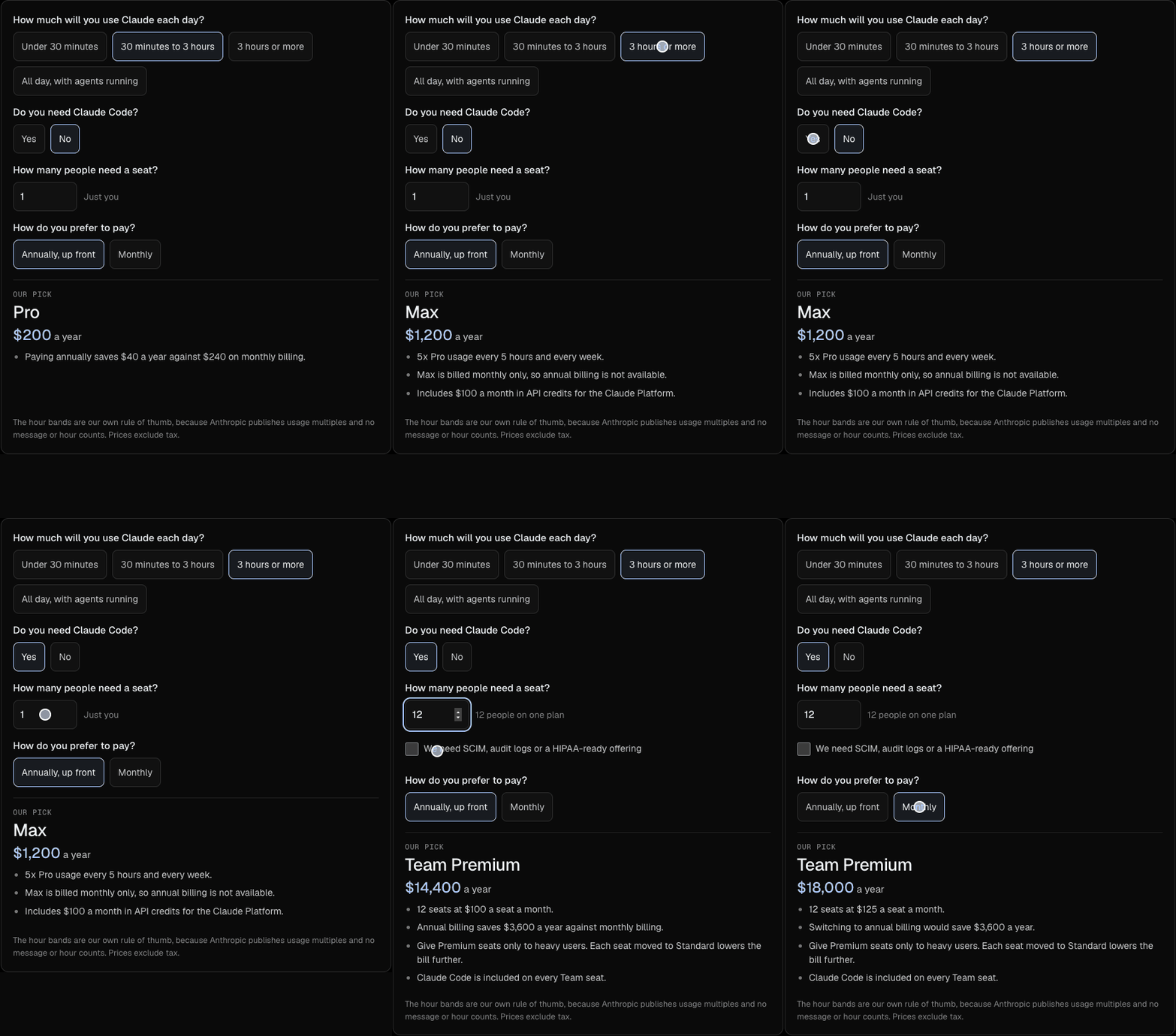
Most solo users belong on Pro, and most teams belong on Team Standard with a few Premium seats. Answer four questions and the picker gives you a plan and a yearly cost, using the prices above. It runs in your browser and sends nothing anywhere.
Our pick
Pro
$200 a year
- Paying annually saves $40 a year against $240 on monthly billing.
The hour bands are our own rule of thumb, because Anthropic publishes usage multiples and no message or hour counts. Prices exclude tax.
Is Claude free?
Yes. Claude has a Free plan at $0 that includes chat on web, desktop and mobile, web search, file creation, code execution, memory, connectors, Artifacts and up to five Projects. It has limited usage every five hours and every week, and it runs Sonnet and Haiku only. Some jobs need no model at all: a sketch idea comes free from our art prompt tool.
Free leaves out Opus, Fable, Research, Claude Code, Claude for Microsoft 365 and Claude in Chrome, according to the feature table on the pricing page. You can't buy usage credits on it either, so a Free user who hits a limit can only wait or upgrade. Anyone in a supported location can sign up with an email address.
Pick Free if you ask Claude a few things a week, or if you're comparing it with other assistants before paying. Move to Pro the first time a limit interrupts real work.
How much is Claude Pro?
Claude Pro is $20 a month, or one $200 payment for the year. That's $16.67 a month, shown as $17 on the pricing page, and a saving of $40. Pro gives you at least 5x Free's usage per five-hour session, plus Opus, Claude Code and Research, and it drops Free's five-Project cap.
Pro has both a five-hour limit and a weekly limit across all models. Fable, Anthropic's top model, isn't part of the plan's limits: on Pro it runs on pay-as-you-go usage credits, per its Fable plan article. Pro also doesn't include API use through the Console, so a developer who wants both pays for the API separately.
Anthropic's own pages disagree on one Pro benefit. The Pro help article lists priority access during high-traffic periods, while the comparison table on the pricing page shows priority access as a Max and Ultra feature. If that matters to you, treat it as unconfirmed.
If you code, Pro is the cheapest paid way in, since Claude Code is included and shares one pool with your chats. Our Claude Code cost breakdown covers what that pool lasts and when the API works out cheaper.
How much is Claude Max?
Claude Max costs $100 a month and gives you 5x Pro's usage, both every five hours and every week. It's billed monthly only, with no annual option. Max adds Fable for up to half of your weekly limit, priority access at high-traffic times, early access to new features and $100 a month in API credits.
Max doesn't add a smarter model tier beyond that Fable access. Opus, Sonnet and Haiku are on Pro too, so the upgrade is mostly volume. Fable also uses limits faster than other models, and Max has a separate weekly Fable limit. Once you pass it, you can pay with usage credits or switch models.
An annual Pro payment carries over if you upgrade. Anthropic's Max article says a remaining balance larger than the Max price is stored as account credit for future charges, provided your billing address stays the same.
What is Claude Ultra, and what happened to Max 20x?
Claude Ultra is the $200 a month plan formerly called Max 20x. Anthropic renamed it, moved existing subscribers across at the same price, and now describes it as 10x Pro's usage every week with no five-hour limit for verified accounts. Max 5x is now simply Max. There is no plan called Max 20x any more.
Anthropic's Ultra article states the rename and the 10x weekly allowance directly, and the Claude Code docs confirm both new names. The change matters because the old name implied a number that Anthropic no longer quotes. Compare Ultra with Max on the current terms: double the weekly usage for double the price, and no session limit.
Verification is automatic. Anthropic checks factors such as account and payment history, and a temporary limit applies until it finishes. Confirming your phone number at checkout doesn't remove that limit. To check your status, open Settings, then Usage: if there's no Current session bar, you're verified.
Ultra also carries $200 in monthly API credits, double Max's $100, and the same half-of-weekly cap on Fable. Pick Ultra if five-hour resets stop your work. If your problem is the weekly total and you can live with sessions, Max plus occasional usage credits may be cheaper.
What do 5x and 10x actually mean?
Each multiple is a share of Pro's allowance, and that allowance has no published message count. Max's 5x means five times whatever Pro allows in the same five-hour session and the same week. Anthropic publishes no fixed number, because usage depends on conversation length, files, the model, effort level and features.
Two clocks run at once. The five-hour window starts with your first message and resets in full five hours later. The weekly clock resets at a set time tied to your account, shown in Settings under Usage. Claude Code, chat, mobile and the desktop app share one pool, so a long coding session eats into your chat allowance.
| Plan | Per 5-hour session | Per week | Fable |
|---|---|---|---|
| Free | Limited | Limited | No |
| Pro | 1x (at least 5x Free) | 1x | Usage credits only |
| Max | 5x Pro | 5x Pro | Up to 50% of weekly limit |
| Ultra | No limit if verified | 10x Pro | Up to 50% of weekly limit |
| Team Standard | 1.25x Pro | Weekly limit, multiple not published | Usage credits only |
| Team Premium | 6.25x Pro | Weekly limit, multiple not published | Up to 50% of weekly limit |
Dividing each price by its multiple shows how the ladder is built. Every monthly-billed plan works out to exactly $20 per Pro-sized unit of usage. Annual billing is the only thing that moves the rate, to $16.67 on Pro and $16 on Team seats.
What do you get on each Claude plan?
Most features unlock at Pro. Going from Free to Pro adds Claude Code, Opus, Research, scheduled tasks, Claude in Chrome and Microsoft 365, unlimited Projects and the option to buy usage credits. Max and Ultra add no new apps to the comparison table: they add usage, Fable within the plan, priority access and monthly API credits. Team adds the admin and sharing layer.
| Feature | Free | Pro | Max | Ultra | Team |
|---|---|---|---|---|---|
| Claude Code | No | Yes | Yes | Yes | Yes |
| Opus | No | Yes | Yes | Yes | Yes |
| Fable | No | Usage credits only | Up to 50% of weekly limit | Up to 50% of weekly limit | Up to 50% of weekly limit, Premium seats |
| Research | No | Yes | Yes | Yes | Yes |
| Projects | Up to 5 | Yes | Yes | Yes | Yes |
| Hand off and schedule tasks | No | Yes | Yes | Yes | Not listed |
| Claude Dashboards (beta) and Claude Science | No | Yes | Yes | Yes | Yes |
| Claude in Chrome, Microsoft 365 and Outlook | No | Yes | Yes | Yes | Yes |
| Claude Design, Slides and Docs | Yes | Yes | Yes | Yes | Yes |
| Claude Motion (beta) and Claude Tag | No | No | No | No | Yes |
| Enterprise search and project sharing | No | No | No | No | Yes |
| Usage credits past your limit | No | Yes | Yes | Yes | Yes |
| Monthly API credits | No | No | $100 | $200 | Up to $500, pooled |
| Priority access at busy times | No | No | Yes | Yes | Yes |
| SSO and central billing | No | No | No | No | Yes |
| Model training on your content | Opt-out | Opt-out | Opt-out | Opt-out | None by default |
| Billing cycle | None | Monthly or annual | Monthly | Monthly | Monthly or annual |
Every row comes from the feature comparison tables on both tabs of Anthropic's pricing page. The Team tab doesn't list scheduled tasks, so we marked it as not listed rather than guessing. Every plan, Free included, lists a context window of up to 1M tokens, varying by model.
The table shows where the money goes on each upgrade. Pro is the feature upgrade. Max and Ultra are volume upgrades with a few extras attached, and the biggest extra is easy to miss: the monthly API credit equals the plan fee.
Max at $100 comes with $100 a month to spend on the Claude Platform, and Ultra at $200 comes with $200. If you would pay for that much API usage anyway, say for a side project or an internal tool, the credits cover a large share of the subscription. Two limits apply: the credits don't roll over, and they don't work in interactive Claude Code, so they don't stretch your chat or coding allowance.
How much is Claude for a team?
Claude Team costs $25 per Standard seat a month, or $20 on annual billing, and $125 per Premium seat, or $100 annual. It covers 2 to 150 seats, and you can mix seat types. Usage limits apply per member rather than across the team, so one heavy user can't drain a colleague's allowance.
The minimum is two members, per Anthropic's Team article. Every Team seat includes Claude Code, Claude Cowork, SSO and central billing, and Anthropic doesn't train on Team content by default. Premium seats add 5x the usage of Standard and Fable for up to half of weekly limits. Standard seats reach Fable through usage credits.
Team is paid by credit card, with no ACH or invoicing, according to the Team and Enterprise comparison table. That table also shows role-based access, SCIM, audit logs and a HIPAA-ready offering as Enterprise features. The Team help article mentions role-based permissioning and a 200k context window where the table says up to 1M, so confirm those two with Anthropic if your decision depends on them.
A 10-person company with 8 Standard and 2 Premium seats pays $360 a month on annual billing, or $4,320 a year. That same mix earns $360 a month in API credits.
Team seats carry monthly Platform credits of $20 per Standard seat and $100 per Premium seat, pooled and capped at $500 a month. On annual billing, that credit equals the seat price until you reach the cap. A team that already spends on the API can offset much of its seat bill, though credits don't cover interactive Claude Code.
What does Claude Enterprise cost?
Claude Enterprise lists at $20 a seat each month on annual billing, with all usage charged on top at API rates. The seat fee includes no usage allowance, so your total depends on models and tasks. The self-serve route has a 20-seat minimum, or $4,800 a year before usage, and the sales-assisted route needs 50 seats.
Enterprise adds role-based access, SCIM, audit logs, a Compliance API, custom data retention, IP allowlisting and a HIPAA-ready offering. Sales-assisted buyers also get invoicing and net terms. Some older customers remain on seat-based Enterprise plans, and those end at their next contract renewal.
Coding is the budget risk. Anthropic's Claude Code docs put enterprise deployments at around $13 a developer on each active day, or $150 to $250 a developer each month, and 90% of users stay under $30 on an active day. Fifty developers at those averages cost $90,000 to $150,000 a year in usage, on top of $12,000 in seat fees.
For comparison, 50 Team Premium seats on annual billing cost a fixed $60,000 a year, with limits. Pick Team if a predictable bill matters more than open-ended usage and you can live without SCIM and audit logs. Pick Enterprise if you have more than 150 people or those controls are required.
What happens when you hit a usage limit?
You have three options at a usage limit: wait for the reset, upgrade, or turn on usage credits and keep working at standard API rates. Credits are prepaid, billed separately from your subscription, and available on paid plans only. You can set a monthly spend cap in Settings under Usage.
Three similarly named balances get mixed up:
- Usage credits are money you add to keep using Claude after a limit, at standard API rates. They work in chat and Claude Code.
- Usage bundles are prepaid usage credits at a discount: $50 for $45, $250 for $200 and $1,000 for $700. Individuals can buy up to $2,000 of value a month, and Team owners up to $3,000.
- Monthly API credits are included on Max ($100), Ultra ($200) and Team. They work only on the Claude Platform, for your own apps and agents. Interactive Claude Code and extra usage in the apps are excluded, the balance expires each billing cycle, and you claim it after seven days on the plan by linking one Console organization.
Pro and Enterprise plans aren't eligible for monthly API credits. If you already spend $100 or more a month on the Claude API through one Console organization, Max's credit covers the whole subscription fee.
What does the Claude API cost?
The Claude API is billed per million tokens (MTok), separately from any subscription. Fable 5.1 costs $10 input and $50 output, Opus 5.5 costs $4 and $20, Sonnet 5.5 costs $2 and $10, and Haiku 5.5 costs $0.10 and $0.50 for prompts up to 100,000 tokens. Batch processing halves those rates.
| Model | Input | Output | 5-min cache write | Cache hit | Batch in / out |
|---|---|---|---|---|---|
| Fable 5.1 | $10 | $50 | $12.50 | $0.25 | $5 / $25 |
| Opus 5.5 | $4 | $20 | $5 | $0.20 | $2 / $10 |
| Sonnet 5.5 | $2 | $10 | $2.50 | $0.10 | $1 / $5 |
| Haiku 5.5, prompts up to 100,000 tokens | $0.10 | $0.50 | $0.125 | $0.01 | $0.05 / $0.25 |
| Haiku 5.5, prompts over 100,000 tokens | $0.50 | $2.50 | $0.625 | $0.05 | $0.25 / $1.25 |
All figures are USD per million tokens from Anthropic's API pricing docs. Older models stay on sale at different rates; Opus 5, for example, is still $5 and $25. A few modifiers apply on top: US-only inference through inference_geo costs 1.1x, fast mode on Opus 5.5 costs $8 and $40, and every 1,000 web searches add $10 plus the tokens they use.
A support bot. Take 10,000 tickets a month, each with 2,000 input tokens and 400 output tokens. That's 20 million input and 4 million output tokens, which costs $4 on Haiku 5.5, $80 on Sonnet 5.5, $160 on Opus 5.5 and $400 on Fable 5.1.
Fifty questions on one long document. Sending a 100,000-token report 50 times on Sonnet 5.5 costs $10 for the report's input tokens alone. With prompt caching, the first request writes the cache for $0.25 and the next 49 reads cost $0.49, for a total of $0.74. That's about 93% less, as long as the requests keep the cache alive.
An overnight content job. Generating 5,000 pieces on Opus 5.5 at 1,000 input and 2,000 output tokens each costs $220. Sent through the Batch API, the same job costs $110.
The Haiku threshold. Haiku 5.5 is priced on the length of each prompt, and the prompt's total includes cached tokens. A 99,000-token prompt costs about $0.0099 in input. A 101,000-token prompt costs about $0.0505, more than five times as much for 2% more text. Keep Haiku prompts under the line, or check whether Sonnet is the better fit.
Anthropic says Claude 4.7 and later models use a tokenizer that turns identical text into roughly 30% more tokens. Opus 5.5's $4 input rate, scaled by that figure, behaves like about $5.20 against the older tokenizer, so a move from Opus 4.6 at $5 may not lower your bill even though the list price fell. Measure with your own prompts.
Has Claude gotten cheaper?
On the API, yes, and by a lot. Opus input fell from $15 per million tokens on Opus 4 and 4.1 to $5 on Opus 4.5 through Opus 5, then to $4 on Opus 5.5. Sonnet went from $3 to $2, and Haiku from $1 on Haiku 4.5 to $0.10 on Haiku 5.5 for prompts up to 100,000 tokens. Older models stay on sale at their old rates.
| Family | Older model, input / output | Middle generation, input / output | Current model, input / output |
|---|---|---|---|
| Opus | Opus 4 and 4.1: $15 / $75 | Opus 4.5 to Opus 5: $5 / $25 | Opus 5.5: $4 / $20 |
| Sonnet | Sonnet 4 to 4.6: $3 / $15 | Sonnet 5: $2 / $10 | Sonnet 5.5: $2 / $10 |
| Haiku | Haiku 4.5: $1 / $5 | None listed | Haiku 5.5: $0.10 / $0.50 up to 100,000 prompt tokens, $0.50 / $2.50 above |
| Fable | None listed | Fable 5: $10 / $50 | Fable 5.1: $10 / $50 |
All rates are per million tokens from the model and additional models tables on Anthropic's API pricing docs. Anthropic doesn't publish launch dates on that page, so the columns group models by generation, not by year.
Three things keep the drop from being as large as the chart suggests:
- The tokenizer. Every model from Claude 4.7 on splits text into about 30% more tokens, so Opus 5.5's $4 behaves like roughly $5.20 next to an older Opus, as the API section shows.
- Cache hits fell faster than list prices. Sonnet 5 and Sonnet 5.5 share a $2 input price, but a cache hit is $0.20 on Sonnet 5 and $0.10 on Sonnet 5.5. Fable 5 and Fable 5.1 both cost $10, with cache hits at $1 and $0.25.
- Subscriptions didn't move. Pro is still $20, and the plan once called Max 20x kept its $200 price when it became Ultra. Cheaper tokens show up on plans as more work per limit, not as a lower fee.
Haiku is the standout. Haiku 5.5 at $0.10 is a tenth of Haiku 4.5's $1 input rate, as long as the prompt stays under 100,000 tokens. That makes it the cheapest way to run classification or routing on Claude, and the threshold covered above is the one place it can surprise you.
What does Claude cost per year?
Claude costs $200 a year on annual Pro, $240 on monthly Pro, $1,200 on Max and $2,400 on Ultra, before tax. A Team Standard seat costs $240 to $300 a year and a Premium seat $1,200 to $1,500. An Enterprise seat is $240 a year plus usage.
| Plan | Per year, paid monthly | Per year, paid annually | Annual saving |
|---|---|---|---|
| Free | $0 | $0 | None |
| Pro | $240 | $200 | $40 |
| Max | $1,200 | Not offered | None |
| Ultra | $2,400 | Not offered | None |
| Team Standard, per seat | $300 | $240 | $60 |
| Team Premium, per seat | $1,500 | $1,200 | $300 |
| Enterprise, per seat | Not offered | $240 plus usage | None |
Team seats save 20% on annual billing against Pro's 16.7%. A five-person team on Standard seats saves $300 a year by paying annually, which is worth doing if your headcount is stable.
Is Claude cheaper than ChatGPT or Gemini?
Claude costs about the same as ChatGPT and Gemini at every main tier. Its $200 annual Pro plan is the only individual annual rate shown on the three vendors' plan pages. ChatGPT and Google both sell a budget plan under $10, which Claude doesn't, and ChatGPT adds a $500 tier that has no Claude equivalent.
| Tier | Claude | ChatGPT | Gemini |
|---|---|---|---|
| Free | Free, $0 | Free, $0 | Free, $0 |
| Budget | None | Go, $8 a month ($96 a year), may include ads | Google AI Plus, $4.99 a month ($59.88 a year) |
| Everyday | Pro, $20 a month ($240), or $200 a year | Plus, $20 a month ($240) | Google AI Pro, $19.99 a month ($239.88) |
| Heavy | Max, $100 a month ($1,200) | Pro 100, $100 a month ($1,200) | Google AI Ultra 5x, $99.99 a month ($1,199.88) |
| Top | Ultra, $200 a month ($2,400) | Pro 200, $200 a month ($2,400) | Google AI Ultra 20x, $199.99 a month ($2,399.88) |
| Above top | None | Pro 500, $500 a month ($6,000) | None |
| Team seat | Standard $25 or $20 annual, Premium $125 or $100 annual | Business Standard $25 or $20 annual, Premium $125 or $100 annual | Through Google Workspace, from $7 a user with an annual commitment |
Allowances can't be compared across vendors, because each measures usage its own way, so a matching price doesn't mean matching capacity. Google bundles extras that the others don't: Google AI Pro comes with 5 TB of storage and a YouTube Premium Lite plan. For small teams on Google's suite, Gemini arrives inside Workspace plans that also cover email and storage.
- Pick Claude Pro if you want Claude Code at the entry price, or you'll commit for a year to save $40.
- Pick ChatGPT Go or Google AI Plus if your budget is under $10 a month.
- Pick Google AI Pro if you'd pay for cloud storage anyway.
- Pick ChatGPT Pro 500 if you need OpenAI's Ultrafast option, which is only on that tier.
How can you pay less for Claude?
The simplest ways to pay less are annual billing on Pro or Team, usage bundles for overages, and a smaller model on the API. Anthropic says it has no standing discounts for individual plans and that support can't issue coupons, so a promo code from a third-party site is unlikely to work.
- Go annual on Pro. $200 instead of $240. Switch in Settings under Billing, and unused monthly time is credited to the first invoice.
- Go annual on Team. $60 less per Standard seat and $300 less per Premium seat each year.
- Mix seat types. Give Premium seats only to heavy users. Each swap to Standard saves $960 a year on annual billing.
- Buy bundles for overages. 10% to 30% off usage credits, if you know you'll use them.
- Claim your API credits. They expire each cycle and don't roll over, so an unclaimed credit is money lost.
- Check nonprofit and research pricing. Eligible nonprofits get discounts on Team and Enterprise, and scientists at academic and nonprofit institutions can get a discounted Team plan with limited availability.
- Ask your university. Anthropic's Education plan is sold to institutions, with no individual student rate on its pricing page.
- Use caching and batch on the API. Cache hits cost a small fraction of input, and the Batch API takes 50% off input and output.
- Negotiate at volume. Anthropic says high-volume API users might get volume discounts, and its sales-assisted Enterprise route lists tiered incentives on committed spend. Neither rate is published.
Anthropic does run limited-time promotions, announced through its official channels, so its newsletter is the reliable place to watch for one.
How accurate are other Claude pricing guides?
Most are out of date on the newest changes. We checked 10 third-party Claude pricing guides against Anthropic's live pages, and only 1 named Ultra. Of 140 fact checks, 61 were correct (43.6%), 41 were wrong or stale (29.3%) and 38 weren't stated (27.1%). No page got all 14 facts right.
Older prices are in good shape: 9 pages got Free right and 8 got Max at $100 for 5x Pro. The trouble starts with anything that moved recently. Eight pages still sell a Max plan at $200, seven state its allowance as 20x, and only 1 gives the current Haiku 5.5 price. The best page in the sample scored 10 of 14.
The errors travel. The Overview we saw for the same search described Max 20x at 20x Pro, gave it "up to $500/month in pooled API credits", which is Team's cap, and said Team Standard doesn't include Claude Code. Each of those contradicts Anthropic's pages, and the Max 20x and Team Standard claims also appear in guides we audited.
What do Claude pricing guides get wrong?
Three errors recur: the retired Max 20x name, old API model prices and a false limit on Claude Code for Team seats. All of the claims below appeared in at least one page in our audit, and each is corrected against Anthropic's live pages.
- "Max comes in 5x and 20x tiers." The plans are Max at 5x and Ultra at 10x weekly.
- "Team Standard doesn't include Claude Code." Claude Code is on the Team plan, and Anthropic's Team article lists it for Standard seats. Premium adds usage.
- "Team needs at least five seats." The minimum is two.
- "Team costs $30 a seat, and Premium $150." Standard is $25, or $20 annual. Premium is $125, or $100 annual.
- "Enterprise is custom priced." The list price is $20 a seat with usage billed at API rates, though sales can tailor a quote.
- "Opus costs $5 and $25." True for Opus 5 and Opus 4.5 to 4.8. Opus 5.5 is $4 and $20.
- "Haiku is $1 and $5." That's Haiku 4.5. Haiku 5.5 starts at $0.10 and $0.50.
- "Opus on Pro is billed through usage credits." Opus is included on Pro. Fable is the model that runs on credits there.
- "Pro includes a monthly credit." Monthly API credits apply to Max, Ultra and Team. Pro isn't eligible.
Frequently asked questions
Is a Claude AI subscription worth it?
A Claude subscription is worth it if free limits interrupt your work or you want Claude Code, Opus or Research. Pro at $200 a year is the best value for most people. Max and Ultra suit you only when you reach limits regularly, because each costs the same $20 per Pro-sized unit of usage.
Is Claude AI completely free to use?
Claude has a free plan at $0, but it isn't unlimited. Free includes chat, web search, file creation, memory and up to five Projects on Sonnet and Haiku, with usage limits every five hours and every week. Opus, Claude Code and Research need a paid plan, and API usage is billed separately.
What is the cheapest price for a Claude AI subscription?
The cheapest paid Claude subscription is Pro at $200 a year, or roughly $17 a month. Pro billed monthly costs $20. Anthropic has no budget plan below Pro and says it offers no standing discounts for individual plans, though it occasionally runs limited-time promotions through its official channels.
Can I cancel my Claude AI subscription anytime?
Yes. You can cancel anytime in Settings under Billing, and you keep the plan until the billing period ends. Cancel at least 24 hours before renewal to avoid the next charge. App Store and Google Play subscriptions are cancelled through those stores. Payments are generally non-refundable, except where terms or local law require it.
What are the key differences between Claude Free and Claude Pro?
Pro costs $20 a month and gives you at least five times Free's usage per session. It adds Opus, Claude Code, Research, Projects beyond Free's five, Claude in Chrome, Claude for Microsoft 365 and scheduled tasks. Pro users can also buy usage credits when they reach a limit, which Free users can't do.
Is Claude Pro worth the cost?
Claude Pro is worth the cost for anyone who uses Claude most days or wants Claude Code at the lowest price. It matches ChatGPT Plus at $20 a month and undercuts it at $200 a year. Skip it if you ask only a few questions a week, because the free plan covers that.
Do Claude Max and Ultra include API credits?
Yes. Max includes $100 a month in API credits for the Claude Platform and Ultra includes $200, matching each plan's fee. The credits don't roll over and don't work in interactive Claude Code. Team plans get up to $500 a month pooled, while Free, Pro and Enterprise get none.
Has Claude gotten cheaper?
On the API, yes. Opus input fell from $15 per million tokens on Opus 4 to $5 on Opus 4.5 and $4 on Opus 5.5, and Haiku fell from $1 on Haiku 4.5 to $0.10 on Haiku 5.5 for shorter prompts. Subscription prices stayed the same, and the newer tokenizer counts about 30% more tokens.
Which Claude plans include Claude Code?
Every paid plan includes Claude Code: Pro, Max, Ultra, both Team seat types and Enterprise. The Free plan doesn't. Claude Code shares one usage pool with your chats, so a long coding session uses up the same limit you chat with.
Marksman, Robin. "Claude AI pricing: what every plan and the API cost." AI Ranked, November 5, 2026. https://airanked.ai/guides/claude-pricing