 Robin Marksman
- Your own site is the base layer, not the whole job. Vendors got 37.8% of AI Overview citations on best software queries in our study; the other 62.2% went to YouTube, publishers, forums, review sites and agencies.
- Listicles are the most quoted page type for buying questions. 55.1% of the citations on best queries in our data were list-style pages, and Ahrefs found best X lists made up 43.8% of the pages ChatGPT cited.
- Review sites matter more than their citation count suggests. They took 5.0% of all citations but appeared on 31.0% of our best queries, and 43% of buyers in G2's survey said review sites shape their shortlist.
- Run the steps in order. Off-site work amplifies whatever your site says, including the parts that are wrong.
Why do AI assistants recommend some software and not others?
AI assistants recommend the products that show up most often, and most consistently, in the sources they retrieve for a buying question. For software, those sources are mostly third-party pages: list articles, review platforms, videos and forum threads. A product that's described the same way across many of them gets named. A product that only describes itself usually doesn't.
We measured this directly. In our AI Overview citation study of B2B software queries, 29 best queries across 10 software categories produced 156 citations. Vendors' own pages took 59 of them. Everything else came from other people.
| Source type | Citations | Share |
|---|---|---|
| Software vendors | 59 | 37.8% |
| YouTube | 37 | 23.7% |
| Publishers and media | 27 | 17.3% |
| Reddit, forums and social | 13 | 8.3% |
| Review and listing sites | 12 | 7.7% |
| Agencies and consultants | 7 | 4.5% |
| Other | 1 | 0.6% |
| Total | 156 | 100% |
That split also explains why buyers trust these answers. In G2's survey of 1,076 B2B software buyers (March 2026), 51% said they start their research in an AI chatbot more often than in Google, and 69% said a chatbot led them to a different vendor than they first planned. G2 runs a review platform, so it has a stake in the answer, and the figures are self-reported.
What are the 5 steps to get recommended by AI?
The five steps are: audit your site, earn backlinks and brand mentions, get into the listicles AI quotes, complete your review-site and directory profiles, and show up where buyers ask each other. Each one feeds a different slice of the sources in Figure 1.
| Step | What you do | Owner | Time |
|---|---|---|---|
| 1. Audit your site | Make sure AI crawlers can read it and every page says the same thing about what you sell | Marketing and web | 1 to 2 weeks |
| 2. Earn links and mentions | Get named in context on sites your buyers already read | Content or PR | Ongoing, monthly |
| 3. Get into listicles | Pitch the owners of lists that rank and get quoted for your category | Marketing | 2 to 8 weeks per placement |
| 4. Fix review-site and directory profiles | Categories, pricing and recent reviews on G2, Capterra, Gartner and niche directories | Product marketing | 2 to 4 weeks for the first pass |
| 5. Show up where buyers ask | YouTube demos and honest answers on Reddit and in communities | Product marketing and founders | Ongoing |
Step 1: Audit your own site first
Start with the pages you control, because every later step sends AI engines back to them. A site audit for AI answers checks three things: whether AI crawlers can fetch your pages, whether the pages state plainly what the product is and who it's for, and whether the facts match everywhere (pricing, integrations, category name).
- Crawler access. In our AI crawler access study, 59 of 261 sites (22.6%) disallowed GPTBot in robots.txt, and some of them didn't know it. Run your domain through our robots.txt AI checker before anything else.
- One sentence that defines you. Your homepage, pricing page and About page should describe the product with the same category words a buyer would type. If your homepage says "revenue intelligence" and G2 lists you under "sales engagement", AI engines see two different products.
- Pages for the questions buyers ask. Comparison pages, alternatives pages and a public pricing page are what engines pull when someone asks "X vs Y" or "how much does X cost". If you don't publish an answer, they quote someone else's.
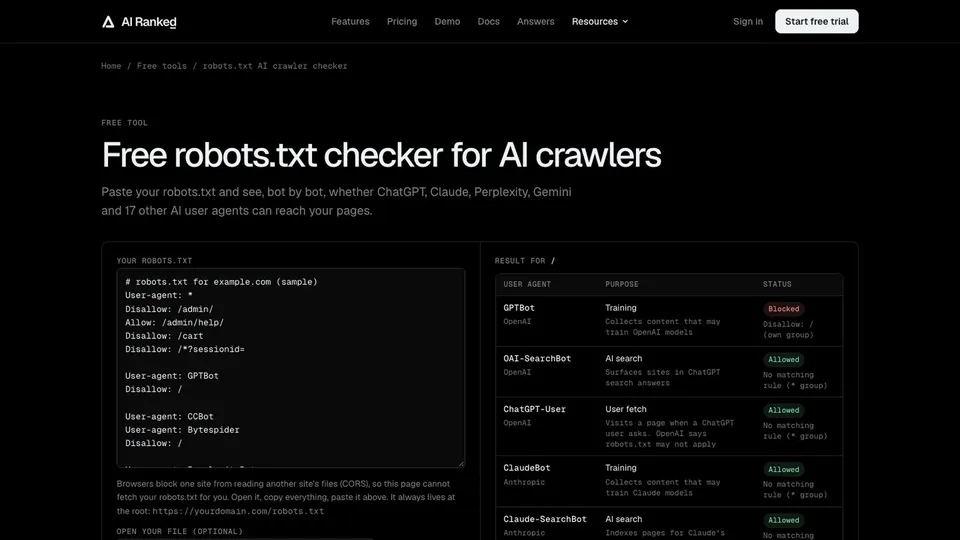
Our GEO audit checklist covers the full list, and schema markup for AI search covers the structured data side.
Step 2: Earn backlinks and brand mentions
Links still help, but mentions of your brand by name seem to matter more for AI answers. When Ahrefs studied 75,000 brands in Google's AI Overviews, the factors most closely tied to being mentioned were all off-site: branded web mentions (correlation 0.664), branded anchors (0.527) and branded search volume (0.392). Ahrefs calls these correlations, not causes, and that's the right way to read them.
- Aim for pages that name your product in a sentence about the problem it solves, not just a logo in a partner grid.
- Guest articles, podcast show notes, integration partner pages and customer case studies all count. Pick sites your buyers actually read; AI engines tend to retrieve the same sources buyers trust.
- Track the anchor text. Branded anchors ("Acme's onboarding tool") help entity recognition more than generic ones ("click here").
Step 3: Get into the listicles AI quotes
List articles are the page type AI engines quote most for buying questions. Best X pages answer the exact question a buyer asks, already compare several products, and are easy for a model to lift a short recommendation from.
Two datasets agree. In our study, 86 of the 156 citations on best queries (55.1%) were list-style pages, and 19 of the 29 best queries cited at least one. Across all 742 citations, including vs and alternatives queries, the share was 36.1%. Ahrefs found the same pattern in ChatGPT: best X blog lists made up 43.8% of 26,283 cited source URLs.
| Dataset | List-style citations | Share |
|---|---|---|
| AI Ranked study, all 122 queries (Google AI Overviews) | 268 of 742 | 36.1% |
| AI Ranked study, 29 best queries | 86 of 156 | 55.1% |
| Ahrefs, ChatGPT source URLs | Best X blog lists | 43.8% |
How to get onto those lists:
- Search your main buying question ("best [category] software") logged out, and ask the same question in ChatGPT and Perplexity. Write down every list that shows up or gets cited.
- Check each list's owner. Some are independent publishers, some are vendors ranking themselves (Ahrefs found that in 169 of 250 best X software searches, or 67.6%), and some are agencies.
- Send the owner a short, useful pitch: what your product does in one line, who it's best for, current pricing, and one proof point they can check. Editors add products that make their list more accurate.
- Publish your own honest list too, if you have the authority for it. A self-ranking list that treats competitors fairly still gets cited.
Step 4: Complete your review-site and directory profiles
Review platforms and software directories give AI engines what they need to compare products side by side: categories, pricing, feature lists and many independent opinions in one place. They're a smaller slice of citations than listicles, but they show up on the queries closest to a purchase.
In our data, review sites were cited on 26 of 122 queries (21.3%) and on 9 of the 29 best queries (31.0%). Gartner (16 citations) and G2 (14) did most of that work; Capterra appeared once. On the buyer side, G2's survey put software review sites second only to AI chatbots as a shortlist influence (43% vs 54%), and 45% of buyers said a review-site citation is the most confidence-inspiring signal inside an AI answer.
| Measure | Value |
|---|---|
| Gartner citations | 16 |
| G2 citations | 14 |
| Capterra citations | 1 |
| Queries citing at least one review site (all 122) | 26 (21.3%) |
| Best queries citing at least one review site (29) | 9 (31.0%) |
What to do, in order:
- Claim and complete the big profiles first. G2, Capterra and Gartner Peer Insights carry most of the weight. Fill every field, including pricing and integrations, and use the same category name you use on your homepage.
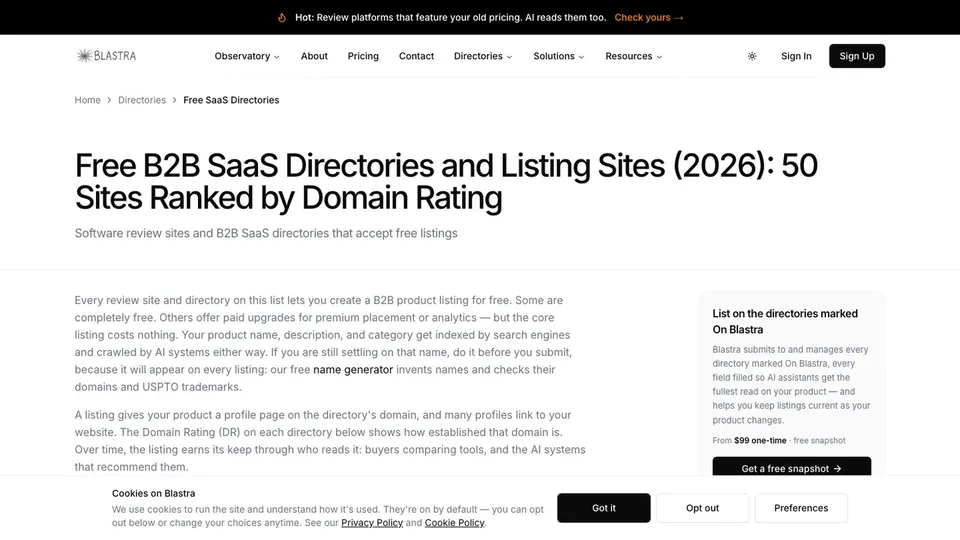
- Then cover the long tail. AI engines also read smaller directories, and many are free to join. Blastra keeps a maintained list of free B2B SaaS directories worth submitting to, plus a guide to alternatives to G2 for teams that want coverage beyond the main three.
- Keep the facts consistent. An old price on one directory and a new price on your site gives an AI engine two answers to choose from. Check profiles whenever pricing or packaging changes.
- Ask for reviews steadily. A burst of reviews in one month looks odd and goes stale. A few new reviews every month keeps profiles current, which is what engines and buyers both read.
Step 5: Show up where buyers ask each other
YouTube and Reddit are the two biggest non-vendor sources in our data. Across all 742 citations, YouTube got 152 (20.5%) and Reddit got 65; together that's 217 citations, or 29.2%. Buyers go there for unscripted opinions, and AI engines follow them.
| Domain | Citations |
|---|---|
| youtube.com | 152 |
| reddit.com | 65 |
| zapier.com | 22 |
| gartner.com | 16 |
| forbes.com | 16 |
| g2.com | 14 |
| salesforce.com | 10 |
| pcmag.com | 9 |
- YouTube: publish short demo and comparison videos titled with the buyer's actual question ("[Product] vs [Competitor] for small sales teams"). Add chapters and a written description, since engines read the text around a video.
- Reddit and communities: answer threads in your category from a named, disclosed account. Help first, mention the product only where it truly fits, and never post fake customer reviews. Moderators remove promotion, and so do AI engines' quality filters over time.
- LinkedIn and Quora: smaller in our data (Reddit, Quora, forums and LinkedIn together made 77 citations), but cheap to cover if your founders already post.
How do you know the recipe is working?
You know it's working when AI answers to a fixed set of buyer questions start naming your product more often, and when the sources they cite include the pages you worked on. Pick 20 to 50 prompts a buyer would ask, run them on the engines your buyers use, and record who gets named and which URLs get cited. Repeat monthly with the same prompts so the numbers are comparable.
Our guide to measuring AI visibility explains the method, and AI Ranked Monitor runs the checks for you if you'd rather not do it by hand. Expect weeks, not days, since engines recrawl and re-rank on their own schedule.
What mistakes slow software companies down?
- Starting off-site before the site is fixed. Every listing and article sends engines back to your pages. If those pages contradict the listing, you lose the benefit.
- Different category names everywhere. Pick one category phrase and use it on your site, on every directory and in every pitch.
- Chasing one big placement. Ten consistent mentions across lists, reviews and threads beat one feature on a famous site.
- Measuring with your own logged-in ChatGPT. Personalization changes the answer. Test logged out or in a temporary chat.
Frequently asked questions
How long does it take to get recommended by AI?
Expect weeks to a few months, not days, because each engine recrawls the pages involved on its own schedule. Fixes on your own site and directory profiles tend to show up first. Listicle placements and community mentions take longer because you're waiting on other people's pages to be published and recrawled.
Do you need backlinks to get recommended by ChatGPT?
Backlinks help, but brand mentions seem to help more. Ahrefs' study of 75,000 brands found branded web mentions had a 0.664 correlation with AI Overview mentions, the strongest factor it measured. Aim for pages that name your product in context, with or without a link.
Which review sites matter most for AI recommendations?
In our data, Gartner and G2 were cited far more than any other review site for B2B software queries, with 16 and 14 citations out of 742. Start there and with Capterra, then add smaller directories in your niche, since engines read those too.
Why do AI assistants recommend listicles so often?
A best-of list answers the buyer's exact question, already compares several products and states who each one suits, so a model can lift a short recommendation from it. In our data, 55.1% of the citations on best software queries went to list-style pages.
Can you pay to be recommended by AI?
Not inside the answer itself. Where AI assistants show ads, they're labelled and kept apart from the recommendation. You can pay for things that influence the sources engines read, such as directory listings or sponsored articles, but sponsored labels and low-quality pages tend to carry less weight. Accurate, consistent information across many independent pages is what moves the result.
Marksman, Robin. "How to get your software recommended by AI: a 5-step recipe." AI Ranked, October 28, 2026. https://airanked.ai/guides/get-software-recommended-by-ai